
Key findings
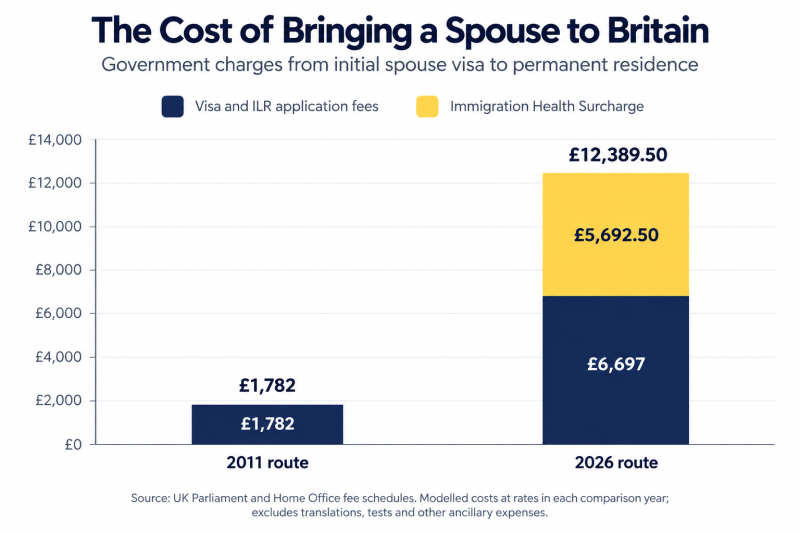
Government charges have increased by approximately 595%. A standard spouse-to-settlement journey that involved £1,782 in application fees in 2011 now carries £12,389.50 in visa fees and healthcare surcharges, based on 2026 rates.
The standard route to permanent residence has grown from two years to five years, introducing an additional visa application and associated administrative requirements.
Fees have far outpaced inflation. UK consumer prices rose approximately 52.5% between April 2011 and April 2026.
Financial evidence has become more prescriptive. Since 2012, most partner applicants have been subject to a minimum income requirement and detailed rules governing the documents used to prove it.
Additional requirements have appeared over time, including A2 English evidence at the extension stage and pre-entry tuberculosis screening for applicants in countries such as India.
The total cost of supporting documentation remains difficult to quantify. Translations, medical tests, certificates and other services vary between applicants and are not captured in headline visa-fee statistics.
The rising cost of bringing a spouse to Britain
For couples separated by international borders, obtaining permission to live together in the UK involves more than submitting a marriage certificate.
Applicants must demonstrate that their relationship meets immigration requirements, prove that they have adequate financial support, satisfy applicable English-language and medical requirements, and provide supporting evidence to the Home Office.
While these obligations have existed in various forms for decades, the process has changed substantially since 2011.
Fifteen years ago, a spouse entering the UK on the standard route could generally apply for permanent residence after two years. Today, most new applicants on the standard family route must complete five years of qualifying residence, ordinarily including a visa extension before applying for indefinite leave to remain (ILR).
The resulting difference in government charges is substantial.
2011 vs 2026: the cost of reaching settlement
| Government charge | 2011 | 2026 |
|---|---|---|
| Initial spouse visa from overseas | £810 | £2,064 |
| In-country partner visa extension | Not required | £1,407 |
| Indefinite leave to remain | £972 | £3,226 |
| Immigration Health Surcharge on initial visa | £0 | £3,105 |
| Immigration Health Surcharge on extension | £0 | £2,587.50 |
| Total | £1,782 | £12,389.50 |
The 2026 calculation assumes one adult applying from overseas, followed by an extension after approximately two and a half years and an application for permanent residence after five years. All charges are held at their October 2026 levels.
The total excludes English tests, the Life in the UK test, certified translations, medical examinations, document procurement and optional professional services.
This represents a nominal increase of approximately 595%, or nearly seven times the 2011 cost.
The comparison is illustrative: the 2011 and 2026 routes differ in duration and requirements, and an applicant beginning the process in 2026 will pay the fees in force when later applications become due, not necessarily today's prices.
Sources: UK Parliament, 2011 immigration fee schedule; Home Office, October 2026 fees; GOV.UK, family visa fees and healthcare surcharge.
How does this compare with inflation?
Between April 2011 and April 2026, the UK's Consumer Prices Index (CPI) increased from 93.2 to 142.1, equivalent to approximately 52.5% cumulative inflation.
If the £1,782 in government application fees associated with the standard 2011 route had increased only in line with consumer prices, the equivalent amount in April 2026 would be approximately £2,717.
Instead, the modelled 2026 government-charge total is £12,389.50.
| Measure | Cost |
|---|---|
| Government application fees, 2011 | £1,782 |
| 2011 fees adjusted for inflation to April 2026 | £2,717 |
| Modelled 2026 government charges, including IHS | £12,389.50 |
| Difference from inflation-adjusted baseline | £9,673 |
The comparison reflects more than price increases. It also captures the addition of an extra visa application and the introduction of the Immigration Health Surcharge.
In real terms, the 2026 government-charge total is approximately 4.6 times the inflation-adjusted 2011 baseline.
Source: Office for National Statistics, CPI time series D7BT.
How the requirements changed: 2011–2026
The increase did not occur through a single policy change. It developed through successive immigration reforms over 15 years.
2011: A two-year route to permanent residence
In 2011, a foreign spouse joining a British citizen could generally receive permission to enter the UK for 27 months.
After completing the required two-year period, they could apply for indefinite leave to remain, provided they met the relevant conditions.
Applicants still needed to establish their identity, demonstrate that their marriage was genuine and continuing, and show that they could be adequately maintained and accommodated without relying on public funds.
A basic A1 English-language requirement had already been introduced in November 2010. Knowledge of language and life in the UK was also required for settlement, subject to applicable exemptions and qualifying routes for meeting it.
The process was not paperwork-free, but there was no general fixed £29,000 minimum income threshold and no Immigration Health Surcharge.
2012: The standard settlement period increases to five years
On 9 July 2012, major changes to the family migration rules took effect.
For most new partner applicants, the normal qualifying period for settlement increased from two years to five years.
The reforms also introduced a general minimum income requirement of £18,600 for sponsoring a partner, with additional requirements for certain dependent children.
Alongside this, Appendix FM-SE established detailed rules governing how financial eligibility should be demonstrated.
For a straightforward salaried employee, these rules ordinarily require evidence such as payslips, corresponding bank statements and a letter from the employer.
The extension of the settlement period also created an additional visa application for couples following the standard route.
Source: Home Office, family migration reforms of July 2012.
2013: Further language and medical evidence requirements
October 2013 brought a B1 English speaking-and-listening requirement for most settlement applicants, alongside the knowledge-of-life requirement.
Pre-entry tuberculosis screening was also being expanded internationally. India was included in the rollout beginning in 2012, with further countries added during 2013.
For applicants subject to screening, this created a medical certificate requirement that had not applied to equivalent applicants in many countries in 2011.
These requirements did not affect every applicant equally. Nationality, country of residence, previous qualifications and exemptions all influence which documents must be supplied.
2015: The Immigration Health Surcharge is introduced
On 6 April 2015, the UK introduced the Immigration Health Surcharge for many migrants coming to live in the country for more than six months.
The initial standard rate was £200 per year.
Unlike ordinary healthcare payments made as services are used, the surcharge is generally paid upfront as part of the immigration application.
This introduced a significant additional charge for spouses applying to live in Britain.
Source: Home Office, introduction of the Health Surcharge.
2017: A2 English requirement for extensions
From 1 May 2017, relevant partners and parents applying to extend their stay after approximately two and a half years became subject to an A2 English-language requirement, unless exempt or already holding acceptable higher-level evidence.
For some applicants, this meant obtaining another qualification and potentially paying for another test.
However, someone who had already passed an acceptable higher-level test might not need to sit an additional examination.
Source: Home Office, A2 English-language requirement.
2024: Higher minimum income and healthcare charges
In April 2024, the general minimum income requirement for most new partner applications increased from £18,600 to £29,000.
The standard Immigration Health Surcharge had also risen to £1,035 per year from February 2024.
Together, these changes affected both financial eligibility and the cost of securing permission to live in the UK.
Transitional arrangements mean that not every family extending a visa in 2026 is subject to the newer £29,000 threshold.
2026: A five-year process with repeated applications
As of October 2026, the standard five-year partner route ordinarily consists of:
An initial partner visa application from overseas.
An application to extend permission after approximately two and a half years.
An application for indefinite leave to remain after completing the qualifying period.
Applicants may have to demonstrate continuing eligibility at successive stages, although the exact evidence differs between an initial application, extension and settlement.
The practical consequence is that many families must gather and update documentation over five years rather than two.
The hidden cost: What documents do families need?
Application fees are easy to identify because the Home Office publishes them.
The cost of preparing supporting evidence is more difficult to establish.
A family may need to obtain official certificates, request records from employers or financial institutions, arrange medical examinations, complete language tests and commission certified translations of documents issued in other languages.
Some of these services are free. Others carry fees that depend on the country, provider or complexity of the case.
Supporting documents: 2011 compared with 2026
| Evidence category | 2011 | 2026 |
|---|---|---|
| Identity and travel history | Passport and relevant immigration history | Passport, relevant immigration history and digital status information where applicable |
| Marriage and relationship | Marriage evidence and proof of a continuing relationship | Marriage evidence and proof of a genuine, continuing relationship |
| Income and maintenance | Evidence of adequate maintenance, without a general fixed salary threshold | Usually £29,000 income for new partner applications, supported by prescribed evidence |
| Bank statements and payslips | Financial documents could be relevant to proving adequate maintenance | Specific documents and evidence periods prescribed according to income type |
| Accommodation | Evidence of suitable accommodation | Accommodation requirements continue |
| English language | A1 at entry, with applicable settlement language requirements | A1 initially, A2 at extension and normally B1 at settlement |
| Tuberculosis testing | Not generally applicable to an Indian spouse under the later expanded programme | TB clearance required for qualifying applicants resident in India |
| Certified translations | Foreign-language records could require translation to support the application | Certified translations explicitly required for documents not in English or Welsh |
The important distinction is between the existence of a document requirement and the degree of detail imposed on applicants.
For example, both 2011 and 2026 applicants had to demonstrate that they could maintain themselves financially.
However, today's Appendix FM-SE specifies the types of financial evidence required according to the source of income, including prescribed periods and document contents.
That does not establish that every individual applicant supplies more separate pages today. It does show that evidence requirements have become more standardised and prescriptive in important areas.
Sources: GOV.UK, family visa supporting evidence; Appendix FM-SE.
What did immigration paperwork look like in 2011?
Historical inspection records provide useful evidence of how immigration applications were assessed before the 2012 reforms.
In a report examining UK visa decisions made during 2011, the Independent Chief Inspector of Borders and Immigration reviewed a settlement application submitted on 19 May 2011.
The applicant had provided bank statements and relationship evidence, including greetings cards and telephone-related records.
Inspectors questioned whether the material adequately established financial support and the continuing relationship. They also found that the UK Border Agency had not retained all relevant supporting evidence.
This historical example illustrates that demonstrating a genuine relationship and adequate financial support could already involve extensive documentation.
The principal development since then has not been the invention of supporting evidence, but the introduction of additional application stages and more detailed rules for particular kinds of evidence.
Why financial documents deserve particular attention
Financial evidence is one of the clearest examples of the difference between the old and current systems.
Consider a British sponsor who has worked for the same employer for more than six months and relies on that salary to meet the financial requirement.
Under the current standard salaried-employment evidence rules, the sponsor would normally need:
Six months of payslips covering the relevant employment period.
Personal bank statements covering the corresponding period and showing salary payments.
An employer's letter confirming employment, salary, employment duration and contract type.
For a person relying on self-employment, company income, savings, pensions or other permitted sources, the documentation can be considerably different and more complex.
The prescribed rules matter because the Home Office assesses not only the level of income but also how that income has been evidenced.
It is also important not to confuse financial eligibility with the cost of obtaining paperwork.
Most applicants can access their own payslips and bank statements without a direct fee. The principal burden may instead be the time involved in gathering, checking and organising the information.
Medical documents: A cost that depends on where you live
For a practical example, consider an Indian national applying to join their British spouse.
India is now covered by the UK's pre-entry tuberculosis screening requirements for qualifying long-term visa applicants.
The applicant must obtain a certificate from a clinic approved by the Home Office.
Published 2026 prices for approved clinics in New Delhi include:
| Approved clinic | Header (if enabled) |
|---|---|
| Indraprastha Apollo Hospital | ₹2,700 |
| Max Med Centre | ₹3,000 |
| Sadhu Vaswani Mission Medical Centre | ₹2,500 |
These are examples rather than a single national test price. Additional investigations, where necessary, may affect the amount paid.
For this reference applicant, the medical certificate represents an additional pre-application expense compared with the position before the screening programme was expanded to India.
Sources: Home Office, TB screening expansion; approved testing clinics in India.
Certified translations: An expense not included in visa-fee statistics
For families whose supporting documents are not issued in English or Welsh, certified translation can form another part of the application budget.
The Home Office requires a certified translation of relevant foreign-language documents submitted with family visa applications.
Depending on an applicant's circumstances, these may include:
Marriage or civil partnership certificates.
Divorce decrees or previous marriage records.
Official name-change documents.
Financial documents issued in another language.
Other civil-status or administrative records relevant to eligibility.
Not all applicants need translations. Even when they do, a single marriage certificate may be sufficient in one case, while another applicant may need several documents translated.
Translation is also not a wholly new feature of the immigration process. Foreign-language records required interpretation or translation before the present family visa rules.
The cost cannot therefore be treated as a newly introduced universal charge.
The more relevant questions are how frequently certified translations are needed, how many documents require translation, and whether applicants must submit additional or updated evidence at later stages.
Unlike visa application fees, there is no government-set standard price for these translations.
The cost depends on factors including source language, document length, complexity and provider.
This makes supporting-document costs a separate area of research from published Home Office fees.
Does the same paperwork have to be submitted three times?
Not necessarily.
A marriage certificate used for an initial spouse visa may remain valid for later applications, provided it continues to establish the relevant fact and meets any applicable evidential requirements.
Likewise, an accepted English-language qualification may be reusable.
However, evidence relating to circumstances that change over time, such as employment income, accommodation or the continuation of a relationship, may need to be updated.
This distinction matters when assessing administrative costs.
A document being requested at multiple stages does not automatically mean that it must be purchased again or translated again.
Some records can be reused, while others must cover a recent period.
The more defensible conclusion is that an additional application creates another administrative checkpoint, potentially requiring updated evidence and additional preparation.
What is the true cost of the paperwork?
The total supporting-document cost is not a single fixed amount.
It can be divided into three broad categories.
1. Mandatory government charges
These include visa application fees and the Immigration Health Surcharge where applicable. They can be calculated directly from published fee schedules.
2. Required third-party services
Depending on the applicant, these can include English-language tests, the Life in the UK test, TB screening and certified translations.
Their costs vary and some applicants qualify for exemptions or can reuse previous evidence.
3. Administrative and incidental costs
Applicants may incur expenses obtaining replacement certificates, travelling to appointments, gathering records or seeking professional assistance.
These expenses are highly dependent on individual circumstances and should not be presented as universal requirements.
For this reason, the £12,389.50 figure in this research represents the modelled government-charge total, not the complete amount every family will spend.
The overall cost can be higher, but establishing a representative average would require additional evidence on applicant expenditure.
What has changed most since 2011?
The research identifies three particularly important developments.
First, the standard route to permanent residence became longer. The change from two years to five years generally introduced an extra visa application and another period during which eligibility must be demonstrated.
Second, financial evidence became more tightly specified. Rather than relying solely on the earlier adequate-maintenance framework, most new partner applicants now face a defined income requirement and detailed supporting-evidence rules.
Third, new charges and selected evidential requirements accumulated. The Immigration Health Surcharge, A2 English requirement and expansion of TB screening each changed the process for affected applicants.
There have also been changes that can simplify particular administrative tasks. Online applications, electronic immigration records and the possible reuse of qualifying evidence mean the present system is not necessarily more paperwork-intensive in every respect.
The evidence therefore supports a more nuanced conclusion than simply saying applicants must submit more documents today.
Conclusion: More than an increase in visa fees
Over the past 15 years, the standard route for a foreign spouse to obtain permanent residence in Britain has undergone substantial changes.
A process that generally involved two immigration applications over approximately two years now ordinarily requires three applications over five years.
At the same time, the modelled government charges associated with reaching settlement have risen from £1,782 in 2011 to £12,389.50 at October 2026 rates.
That increase substantially exceeds general consumer-price inflation, although it also reflects new charges and a different immigration pathway.
The accompanying administrative burden is more difficult to measure.
Couples must continue to document their relationships, finances and eligibility. Some requirements are now more precisely prescribed, while others vary by nationality, employment circumstances and previous qualifications.
The hidden cost is not simply the price of obtaining documents. It is also the time, repeated preparation and additional evidence-gathering associated with a longer journey to permanent residence.
For families navigating the immigration system, understanding the full process — rather than only the initial visa fee — is essential to planning their applications and finances.
Research methodology
This study compares the standard route for a non-British spouse joining a British citizen in the UK, under the rules and fees applicable in April 2011 and October 2026.
The reference scenario assumes one adult applicant, no dependent children, an ordinary salaried British sponsor, and no exceptional circumstances or fee waivers.
The 2011 calculation uses the published £810 overseas settlement visa fee and £972 standard postal ILR fee.
The 2026 calculation uses the published initial family visa fee, in-country extension fee, ILR fee and applicable adult Immigration Health Surcharge amounts.
The 2026 total holds current charges constant across the hypothetical five-year route. It is not an estimate of the fees that will actually be in force five years from now.
Inflation is calculated using the ONS CPI all-items index for April 2011 and April 2026.
Supporting-document comparisons are based on official Immigration Rules, government guidance, contemporary policy announcements and historical inspection material.
Because a complete, standardised dataset of actual documents submitted per family visa application is not available, this study does not claim that the average document count has increased by a particular percentage.
Third-party expenses are excluded from the headline government-charge totals unless explicitly identified.
The study is intended as historical and statistical research, not individual immigration advice.
Primary sources
UK Parliament — Charging for Immigration and Nationality Services, 2011
Home Office — Immigration and Nationality Fees, 8 October 2026
Home Office — Introduction of the Immigration Health Surcharge, 2015
Independent Chief Inspector — Re-inspection of the Abu Dhabi and Islamabad Visa Sections
About Certling
Certling provides certified translations of official documents for immigration, visa, legal and administrative applications. The company works with documents including birth certificates, marriage certificates, academic records and financial statements for applicants in the UK and internationally.